

Testing and Purifying Private Water Systems (Wells)
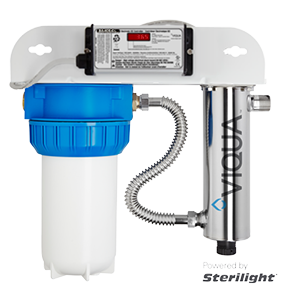
Viqua VH200-F10 | List Price: US$ Our Price: US$1,016.00 You save: $179.00 |
Although the vast majority of Americans get their water from a treated municipal water source, more than 42 million Americans have privately-owned water supplies (wells, lakes, river, etc.). The responsibility to maintain private wells and water systems, including ongoing testing and purification, generally rests with their owners. Very few regulations exist to govern the quality of private well water supplies. Typically, well water is required to be evaluated for microbiological contamination only at the time the well is initially installed. Some progressive health departments require microbiological testing when the property changes ownership as well. During routine day-to-day operation however, it is up to the well owner to monitor and ensure the quality of his own well water supply.
| Quick Menu: |
|---|
Recent stories in the media regarding waterborne illnesses have heightened concerns about drinking water and the need for proper purification. The reality is that almost every water source is contaminated to some degree - some naturally, some by man-made chemicals introduced to the water table through industry, agriculture, leaking or poorly-constructed septic systems, or other means. This is particularly true of shallow water wells. Ground water from deep, drilled wells is naturally filtered and is generally relatively pure and free of biological contamination. However, contamination may occur following improper installation of well casings or caps, after a break in the casing or as a result of contaminated surface water entering the well. Contamination can also occur if wells are drilled in fractured bedrock without an adequate layer of protective soil and with less than the recommended minimum casing length. Most surface water (lakes and rivers) is generally significantly polluted and must be treated before drinking.
Testing Your Water Supply
It is vital that all well owners test their water for contaminants when they first purchase their property and roughly each year subsequently. You should also test your water if:
- you have noticed a change in the taste or smell of your water.
- new industry has moved into your area
- if a new baby is expected in the household (it is a good idea to test for nitrate in the early months of a pregnancy, before bringing an infant home, and again during the first 6 months of the baby's life).
- if you have performed any maintenance on your well or installed a new pump
The nature of the tests you have to do will depend on the known or common contaminants in your area, your proximity to potential pollution sources, and other factors. Many county health departments offer water testing, or you may want to consider using an accredited private testing laboratory.
The following is a list of basic tests private well owners or homeowners who get their water supply from wells, lakes, rivers, or other untreated sources should consider:
- Microbiological testing for total coliforms and E.coli should be performed annually to determine if any bacteria are present in the water supply. Total coliform bacteria are generally harmless and occur naturally in soil and in the intestines of humans and animals. However, their presence in your water supply may indicate fecal contamination. E. coli are present only in the gut of humans and animals. Their presence therefore indicates definite fecal (sewage) pollution requiring immediate attention. There is no safe level of E. coli in drinking water.
- To determine the impact of nearby agricultural operations or on-site septic systems, private well users should have their water analyzed each year for nitrates/nitrites.
- A hardness test can be performed to determine if a hard water condition exists. Hard water can leave skin feeling dry, cause hard water deposits on shiny surfaces, and build up over time in appliances. The presence of hard water conditions may affect your choice of water purification products.
- The pH level of your water should be checked to determine whether your water is acidic. Water with a low pH (less than 7.0) is acidic and may result in the leaching of copper and lead from residential plumbing. Copper leaching will be indicated with a bluish-green stain; an analysis for lead will need to be performed to determine if lead leaching is a problem.
- If the area in which you live is known to have high arsenic levels in the groundwater, a test for arsenic concentration should be performed at least annually.
- If your home is located within a half mile of a gas station or chemical refinery, a BTEX and MTBE analysis should be conducted annually. This is a volatile organic analysis to detect the presence of gasoline and/or the gasoline additive MTBE.
- If you live in a region of the country where radon is known to be a problem, have your water analyzed for radon. If radon is detected, you may also want to have their indoor air analyzed for radon as well.
- If you have a private well and live in an area where pesticide use is common, such as near a golf course, orchard, or agricultural area, you may also want to consider having your water analyzed for pesticides.
- If a rotten egg odor is emitted from your well water, you may want to consider a hydrogen sulfide and methane analysis.
- If there is a musty or moldy odor with your well water, an iron bacteria analysis should be conducted.
- If you are experiencing problems with red staining of plumbing fixtures, the iron level of the well water should be analyzed.
- If you are experiencing problems with brown or black staining of white laundry, have your water checked for manganese.
| Problem | Likely Cause | Recommended Treatments |
|---|---|---|
| hard water deposits on kettles, pots, hot water heaters, humidifiers | excess calcium | Water softener TAC Hard Water Conditioner Reverse osmosis Low Maintenance Humidifier Tankless Water Heater |
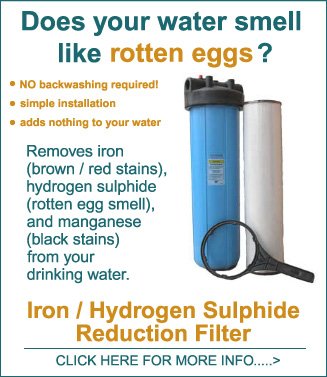
| rusty red or brown staining of fixtures or laundry and/or your water has a metallic taste | excess iron | Whole-house iron reduction filter |
| black staining of fixtures or laundry | excess manganese | Whole-house iron reduction filter |
| rotten egg smell from water | Hydrogen sulfide | Whole-house iron reduction filter |
| water has laxative effect | excess sulfates | Reverse osmosis |
| water is gritty, muddy, or appears dirty | excess sand, silt, dirt, clay, or other sediments in your water | Whole-house cartridge filter Backwashing sediment filter |
The best time to sample your well water is when the probability of contamination is greatest. This is likely to be in early spring just after the thaw, after an extended dry spell, following heavy rains or after lengthy periods of non-use.
If you use a private laboratory to conduct the testing, nitrate and bacteria samples will typically cost between $10 and $20 to complete. Testing for other contaminants will be more expensive. For example, testing for pesticides or organic chemicals may cost from several hundred to several thousand dollars. The lab will supply you with a clean, sterile sample bottle and the necessary instructions. Samples collected in any other container will not yield meaningful results and will likely not be accepted by the laboratory. In all instances, samples should be refrigerated immediately and transported to the laboratory within 24 hours. Most laboratories mail back the sample results within days or several weeks. If a contaminant is detected, the results will include the concentration of the contaminant and an indication of whether this concentration exceeds a drinking water quality standard.
Once your water has been analyzed, you can compare your test results against EPA or state / provincial drinking water regulations to see if any contaminants are exceeding recommended levels. Once you have identified if any problems exist, you can begin your search for a specific treatment for your well water.
It is important that you conduct follow-up testing of the treated water to ensure that it has indeed solved your contamination problems. Follow-up testing should be conducted several times throughout the first year of operation of the treatment system and after any adjustments are made to the system.
You should continue to monitor the quality of your well water at least annually or more frequently if you have reason to believe a new contaminant or contaminants may have entered your water supply or that your system is not catching all intended contaminants.
Well Water Treatment
The treatment of well water will depend on the outcome of your water quality tests. Some water quality problems are better handled through point-of-entry applications, such as color and odor problems or conditions such as hardness. Other contaminants can be best handled through point-of-use devices (reverse osmosis, for example). Keep in mind that some treatment technologies may require that you pre-treat the water in order for the product to be effective. For example, reverse osmosis systems designed for arsenic or nitrate reduction will last longer if hard water is softened prior to entering the unit. In addition, arsenic can be present in water in two forms - if your water contains trivalent arsenic (Arsenic 3 or Arsenite), pre-chlorination will be required prior to using a reverse osmosis system.
Well Maintenance
You should also take steps to protect your water supply from contamination. The following are a few suggestions:
- Periodically inspect exposed parts of the well for problems such as a cracked, corroded, or damaged well casing, or broken or missing well cap, and settling and cracking of surface seals.
- Slope the area around the well to drain surface runoff away from the well.
- Install a well cap or sanitary seal to prevent unauthorized use of, or entry into, the well.
- Keep accurate records of all well maintenance.
- Hire only certified well drillers and contractors for any new well construction, modification, or abandonment and closure work.
- Avoid mixing or using pesticides, fertilizers, herbicides, degreasers, fuels, and other pollutants near the well. Hazardous chemicals also should be kept out of septic systems.
- Do not dispose of wastes in dry or abandoned wells.
- Do not cut off the well casing below the land surface.
- Pump and inspect septic systems as often as recommended by your local health department.


